Pilates for Hypertrophy: Myth vs Reality + 7-Step Muscle Plan
Can Pilates build muscle for hypertrophy? Discover the 7-step system to program progressive overload, choose the right style, and track real growth.

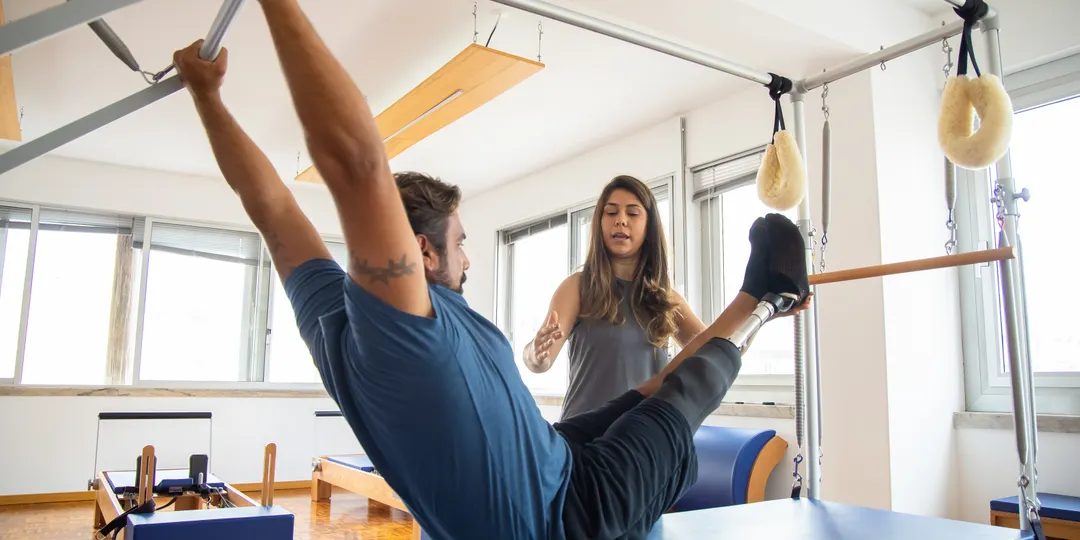
Pilates can build muscle, but only when programmed with sufficient mechanical tension, metabolic stress, and progressive overload — variables standard mat classes often lack. Research confirms that high-intensity reformer or loaded mat Pilates can elicit hypertrophy in untrained to moderately trained individuals, though absolute gains plateau below traditional resistance training ceilings. This article delivers a 7-step evidence-based roadmap to restructure Pilates into a genuine hypertrophy stimulus, covering equipment selection, overload tactics, nutrition specifics, and integration with weight training.
Step 1: Can Pilates Alone Build Muscle? What the Research Shows
Pilates for muscle building and flexibility is a common search intent because marketing often blurs the line between "toning" and hypertrophy. Electromyography (EMG) studies show reformer exercises like footwork, long stretch, and chest press can reach 60–80% MVC (maximal voluntary contraction) in prime movers — sufficient for hypertrophy in novices per ACSM guidelines. However, research indicates that standard mat Pilates rarely exceeds 40–50% MVC without external load, making it suboptimal for continued growth past the "newbie gains" phase. The verdict: Pilates can build muscle initially, but progressive load management is non-negotiable for sustained hypertrophy.
Common Pitfall: Assuming "feeling the burn" equals mechanical tension. Metabolic stress alone drives limited growth without high motor-unit recruitment.
Step 2: Which Pilates Style Is Best for Hypertrophy? Reformer vs Mat vs Clinical

Reformer Pilates hypertrophy potential surpasses mat and clinical variants due to adjustable spring resistance allowing 8–12 rep max loading — the classic hypertrophy rep range. Clinical Pilates prioritizes motor control and rehab (low load, high volume), while standard mat relies on bodyweight leverage, quickly hitting a ceiling. For home trainees, a tower unit or heavy resistance bands anchored to a door replicate spring curves effectively. If equipment is limited, the no-equipment leg progression uses single-leg pistol progressions, shrimp squats, and glute-bridge variations on a slider — these bridge the gap between Pilates control and hypertrophy mechanics. For a complete no-equipment framework, see our guide on home muscle building without equipment.
Common Pitfall: Staying on light springs for "form" past week three. Hypertrophy demands load that makes the last 1–2 reps technically difficult.
Step 3: How to Apply Progressive Overload in Pilates for Muscle Growth
Progressive overload Pilates programming mirrors weight-room logic: increase resistance (spring tension), volume (sets × reps), density (rest intervals), or range of motion weekly. A practical mesocycle: Week 1–3 — 3 sets × 10–12 reps at 7/10 RPE; Week 4 — deload; Week 5–7 — 4 sets × 8–10 reps at 8/10 RPE with 10% heavier springs. Track spring color/number and reps in a notebook — if you cannot add load, add a pause at end-range or slow the eccentric to 3 seconds. This mirrors the mechanical tension principle behind progression — the dose-response research ties climbing weekly set volume to growth (weekly volume and muscle growth).
Common Pitfall: Changing exercises weekly instead of progressing the same movement. Consistency beats variety for hypertrophy.
Step 4: Pilates vs Weight Training for Hypertrophy: How to Combine Both

Pilates excels at deep-core stability, scapular control, and unilateral patterning; free weights excel at axial loading and high-force output. A hybrid split for intermediates: Monday/Thursday — full-body barbell/dumbbell (squat, hinge, push, pull); Tuesday/Friday — reformer Pilates hypertrophy focus (heavy leg press, rowing series, chest press); Saturday — optional mobility flow. This avoids interference while using Pilates to fix weak links that limit big lifts. Beginners should start with two days of weights plus one day of Pilates, mastering movement quality before adding frequency.
Common Pitfall: Doing high-intensity Pilates the day before heavy squats. Schedule 48 hours between high-CNS-demand sessions.
Step 5: How to Track Muscle Growth From Pilates Without DEXA Scans
DEXA is gold standard but impractical monthly. Use a triad: (1) tape measurements at standardized sites (mid-thigh, relaxed arm, calf) every 4 weeks; (2) 3-rep max strength tests on key reformer moves (leg press, chest press) — strength gains correlate strongly with hypertrophy in trained lifters; (3) weekly waist-circumference + body-weight average to ensure lean gain. Progress photos in identical lighting/pose add qualitative context. If measurements stall for 6 weeks, increase caloric surplus or training intensity. To estimate your surplus, use a calorie calculator.
Common Pitfall: Relying solely on scale weight. Recomposition masks hypertrophy on the scale.
Step 6: What to Eat for Hypertrophy When Doing Pilates as Main Training

Energy availability drives the anabolic response. Target a daily protein intake of 1.6–2.2 g per kg of body weight, split across 4–5 meals (0.4–0.55 g/kg/meal) per ISSN protein guidelines. Carbohydrates at 4–6 g/kg fuel glycolytic Pilates sets; fats at 0.8–1 g/kg support hormones. Creatine monohydrate 3–5 g daily saturates phosphocreatine stores, boosting rep quality; timing is irrelevant. Use a macro calculator to translate targets into food portions.
Common Pitfall: Undereating carbs because Pilates "doesn't feel like cardio." Glycogen depletion blunts mTOR signaling.
Step 7: Why Pilates Muscle Gains Stall: 5 Common Pitfalls and Fixes
- Insufficient load — fix: test 10RM monthly, adjust springs.
- Neglecting eccentrics — fix: 3-second lowering on every rep.
- Random programming — fix: periodize in 6-week blocks with deload.
- Ignoring lower-body axial loading — fix: add goblet squats or lunges 1×/week.
- Sleep <7 hours — fix: sleep hygiene protocol; CDC recommends 7+ hours for recovery.
Address these before blaming genetics or "metabolic type" — the concept is a marketing construct; energy balance and progressive tension physiology apply universally.
Conclusion
Pilates becomes a hypertrophy tool when you treat springs like plates: load heavily, progress systematically, eat for growth, and track objectively. The 7-step plan above transforms a flexibility routine into a muscle-building system — whether on a reformer, a mat with bands, or a hybrid schedule with barbells. Start this week: pick two compound reformer moves, establish your 10RM, and log every session. Muscle responds to tension, not the name on the studio door.
Frequently Asked Questions
Can Pilates replace weight training for building muscle?
For beginners, high-load reformer Pilates can drive measurable hypertrophy for 6–12 months. Beyond that, absolute load ceilings make external resistance (barbells, dumbbells) necessary to continue progressing.
How much protein do I need if I only do Pilates?
Aim for 1.6–2.2 g per kg of body weight daily, distributed across 4–5 meals. This range supports muscle protein synthesis from the mechanical tension generated in loaded Pilates sessions.
Is creatine necessary for Pilates hypertrophy?
Not necessary, but 3–5 g of creatine monohydrate daily is low-cost, well-researched, and improves high-intensity rep performance — directly supporting the overload required for growth.
How long until I see visible muscle changes from Pilates?
Novices typically see measurable girth changes at 8–12 weeks with consistent progressive overload, adequate protein, and sleep. Track tape measurements monthly rather than relying on the mirror.